
Standard plugs can't handle industrial power needs. This risks equipment failure and serious safety hazards. Industrial plugs and sockets are the professional solution for safe, reliable high-power connections.
An industrial plug and socket is a heavy-duty connector1 designed for high-current electrical applications in harsh environments. Unlike domestic plugs, they feature robust materials, secure locking mechanisms, and specific pin configurations for different voltages and frequencies, ensuring safety and preventing mismatches in industrial settings.
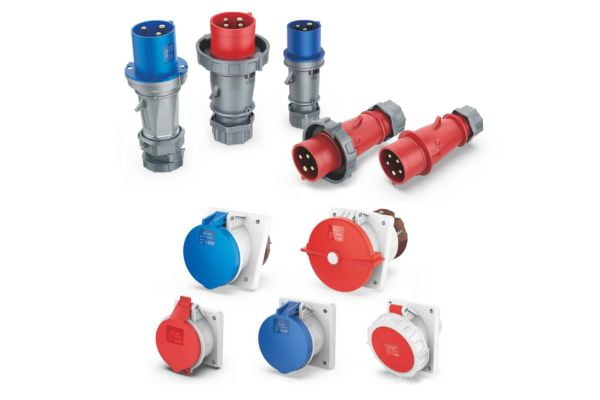
So, you see they are much more than just "bigger plugs." I remember a client, an EPC contractor on a major infrastructure project, who nearly lost a production line because of using the wrong connector type. The small details really matter for safety and uptime. But how do you know which one is right for your project? Let's break down the key features that make these connectors so essential for any serious industrial operation.
At this stage, many buyers start asking practical questions—such as which amperage to choose, whether IP44 or IP67 is suitable, or how to avoid unsafe disconnection under load.
👉 For quick, practical answers, see our full Industrial Plug & Socket – Frequently Asked Questions (FAQ).
How are industrial plugs and sockets2 classified?
Choosing the wrong industrial plug can be a costly mistake. It might not fit, or worse, it could be electrically incompatible. This leads to project delays, reordering costs, and potential safety risks.
Industrial plugs and sockets are mainly classified by their amperage (e.g., 16A, 32A, 63A, 125A), IP (Ingress Protection) rating for dust and water resistance (e.g., IP44, IP67), number of pins, and clock position. This system ensures mechanical and electrical compatibility for different applications.
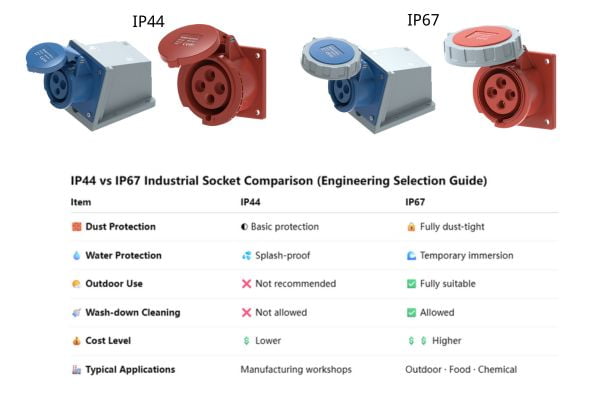
Let's dive deeper into how these classifications work. For us as a manufacturer, these are not just numbers; they are a language of safety and function. We build every product to these strict specifications because we know our clients, from equipment manufacturers to industrial wholesalers, depend on this precision.
Specifications like amperage, IP rating, and clock position often raise detailed selection questions in real projects.
👉 We’ve answered these common concerns in our Industrial Plug & Socket – Frequently Asked Questions (FAQ).
Amperage and Voltage
The first thing you will notice is the current rating, or amperage (A). Our range covers everything from 16A for lighter equipment to 125A for heavy-duty machinery. Mismatching amperage is a fire hazard. Each amperage has a unique size, so you physically cannot plug a 32A plug into a 16A socket. This is a fundamental safety feature. Voltage is also color-coded, which we will discuss later.
IP Ratings
The IP rating3 tells you how well the connector is protected against solids and liquids.
- IP44: This means it is "splash-proof." It’s protected from solid objects larger than 1mm and water splashing from any direction. This is suitable for most indoor factory environments.
- IP67: This means it is "waterproof4" and "dust-tight." It can be temporarily submerged in water and is completely sealed against dust. We often recommend IP67 for clients in food processing, marine applications, or outdoor construction sites where wash-downs and harsh weather are common.
Pin Configuration and Clock Position
The number of pins (3, 4, or 5) determines the type of circuit (e.g., single-phase or three-phase with or without a neutral). The "clock position" refers to the location of the earth pin, which is keyed differently for various voltage and frequency combinations to prevent plugging a 110V plug into a 400V socket.
| Classification | Common Options | Primary Use Case |
|---|---|---|
| Amperage | 16A, 32A, 63A, 125A | Defines power capacity for the connected load. |
| IP Rating | IP44 (Splash-proof), IP67 (Waterproof) | Determines suitability for the operating environment. |
| Pins | 3P, 4P, 5P | Corresponds to the electrical system (e.g., 3-Phase + N + E). |
| Clock Position | 3h, 6h, 9h | Safety keying for different voltage/frequency systems. |
What makes IEC 60309 the global standard?
Your equipment needs to be sold or used globally. Using non-standard connectors creates huge compatibility and safety issues. This can block market access, require costly redesigns, and damage your brand's reputation.
IEC 60309 is the global standard because it provides a unified, color-coded, and mechanically keyed system for industrial plugs and sockets. This ensures that connectors of the same rating are always compatible, while preventing dangerous mismatches between different systems anywhere in the world.
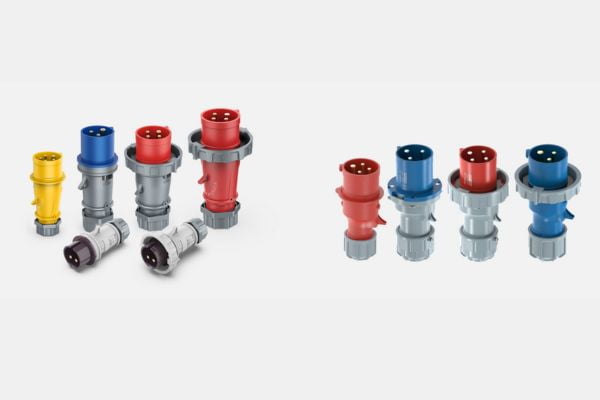
We have been manufacturing these products for decades, and our commitment to the IEC 60309 standard is absolute. It’s the foundation of trust with our global partners. When an equipment manufacturer in Germany buys our connectors for a machine they are shipping to Brazil, they do it with confidence. They know the connections will be safe, compliant, and compatible. This standard removes the guesswork.
Safety Through Design
The standard's core principle is safety. As I mentioned before, plugs and sockets of different current ratings have different physical sizes, making it impossible to connect them incorrectly. Furthermore, the ground pin is thicker and longer than the other pins. This ensures that the ground connection is the first to be made when plugging in and the last to be broken when unplugging. This simple design feature is a critical safety layer that protects both people and equipment.
Global Interoperability
IEC 60309 ensures that a 32A, 400V plug made by us in China will fit perfectly into a 32A, 400V socket made by another certified manufacturer in Europe. For EPC contractors working on international projects or importers serving diverse markets, this is non-negotiable. It simplifies logistics, reduces inventory complexity, and guarantees that temporary power setups on a construction site, for example, are universally compatible. All our products carry global certifications like TUV, CE, and SAA to prove this compliance.
The Color Coding System
The standard uses a simple color-coding system to identify voltage. This visual check prevents serious errors on the factory floor or job site.
| Color | Voltage Range | Common Application |
|---|---|---|
| Yellow | 100-130V | Low voltage, often for construction sites (e.g., in the UK). |
| Blue | 200-250V | Single-phase power, common for equipment in Europe. |
| Red | 380-480V | Three-phase power for heavy machinery and motors. |
This system is incredibly effective. I once visited a client's facility where they used all three voltage types. The clear color-coding made it easy for their maintenance teams to identify circuits instantly, reducing errors and improving efficiency.
When should you choose a switched or interlocked socket?
Simply unplugging a heavy-duty connector under load can create a dangerous electrical arc. It's a major safety risk in any factory. This can cause severe injury, damage equipment, and lead to work stoppages.
Choose a switched socket for local power isolation. Opt for a mechanical interlock in high-risk areas. An interlock physically prevents the plug's removal until the power switch is turned off, eliminating the risk of disconnecting a live circuit and ensuring maximum operator safety.
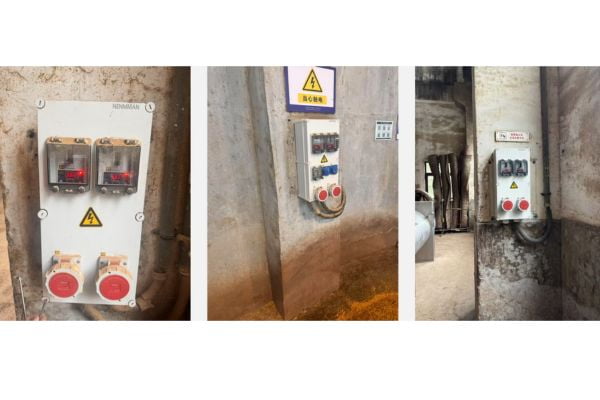
This is a conversation I have frequently with clients who are setting up new production lines. The choice between a standard socket, a switched socket, and a fully interlocked one comes down to a risk assessment. While all our products are safe, interlocks provide the highest level of protection against human error.
Questions about disconnecting under load and when a mechanical interlock is required are very common during safety reviews.
👉 We’ve covered these safety-related questions in detail in our Industrial Plug & Socket – Frequently Asked Questions (FAQ).
The Function of a Switched Socket
A switched socket integrates an ON/OFF switch directly into the socket housing. This is a convenient feature. It allows an operator to de-energize a piece of equipment locally without having to walk back to a main distribution panel. It’s a step up in safety and convenience. However, it still relies on the operator remembering to use the switch before unplugging the connector. For many applications, this is perfectly adequate.
The Ultimate Safety of Mechanical Interlocks
A mechanical interlock5 takes safety to the next level. The design is simple but genius: the switch and the socket are mechanically linked. You cannot insert or remove the plug while the switch is in the "ON" position. And you cannot turn the switch "ON" until the plug is fully inserted. This physically forces the correct, safe sequence of operation. It completely eliminates the possibility of making or breaking a connection under load.
Application Examples
We recently worked with a large food processing company. For their main conveyor lines, they used our standard IP67 sockets. But in the high-pressure wash-down areas, they needed more. We supplied them with our IP67 mechanical interlocks. Their safety manager was adamant that any connection near water and cleaning crews had to be foolproof. The interlock ensures that even during hectic cleaning schedules, an operator cannot accidentally create an electrical hazard by pulling a live plug. For high-power machinery, mining equipment, or any area with inexperienced operators, we almost always recommend a mechanical interlock.
| Feature | Standard Socket | Switched Socket | Mechanical Interlock |
|---|---|---|---|
| Disconnect under load? | Possible (Dangerous) | Possible if switch is ignored | Impossible by design |
| Local Power Control? | No | Yes | Yes |
| Best For | General use, controlled areas | Convenience, local isolation | High-risk areas, maximum safety |
How does OEM/ODM customization work for industrial plugs?
Standard industrial plugs don't always meet your unique product requirements or branding needs. This can force you to compromise on your design or make your product look generic and uncompetitive.
A dedicated OEM/ODM partner can build custom plugs and sockets, from mold design to final assembly, matching your exact specifications. OEM/ODM customization involves a collaborative process. We start with your technical requirements (voltage, current, materials) and branding needs. Our team then handles R&D, mold design, injection molding, assembly, and testing to deliver a unique, certified product that is exclusively yours, ready for mass production.
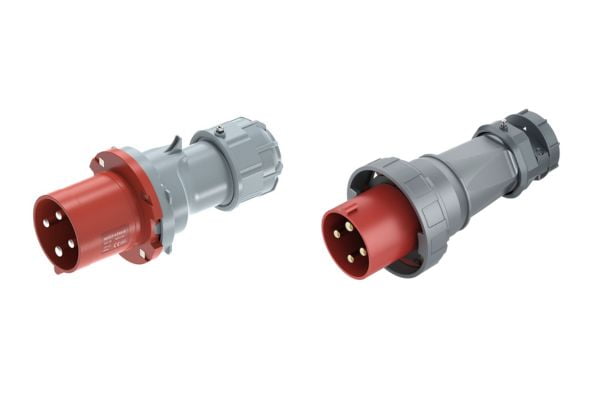
This is the core of our business and what sets us apart. As a manufacturer with a 60-year history under the CHBEB Group, we are not just a supplier; we are a manufacturing partner. Many of the world's leading electrical brands rely on our one-stop manufacturing capabilities to build their product lines.
From Concept to Reality
The process begins with a conversation. A client, often an equipment manufacturer, will come to us with a challenge. For example, a few years ago, a major player in cold chain logistics needed a specialized reefer container plug with a 3-hour (3h) clock position, which was uncommon at the time. Their existing suppliers couldn't deliver. Our R&D team took their requirements, designed new tooling, and created a prototype within weeks. We handled everything: mold design, injection molding with high-impact PC materials, assembly, and full testing to get CCS (China Classification Society) certification for marine use. They now have a proprietary product that gives them a competitive edge.
Material and Branding Customization
Customization goes beyond just technical specs. For our OEM partners, branding is king. We offer a range of customization options to make the product truly theirs. This includes:
- Custom Colors: We can mold the plug and socket housings in a specific brand color (Pantone matching).
- Private Labeling: We can add the client's logo and part numbers directly onto the product, either through molding or high-durability laser marking.
- Custom Packaging: We design and produce packaging that reflects the client's brand identity.
Specialized Solutions
Our flexibility allows us to serve niche markets that others can't. We have developed extra-low voltage plugs for confined space applications, high-current connectors for port machinery, and unique configurations for specific international markets. Our entire process, from R&D to final testing, is in-house. This gives us complete control over quality and allows us to be incredibly responsive to custom requests, whether it's for a project-based bid or a long-term strategic OEM partnership.
Conclusion
Industrial plugs and sockets are essential for safety and reliability. Understanding their classification, standards, and custom options helps you build robust and compliant systems for any industrial application.
Learn about heavy-duty connectors and their role in ensuring safe and reliable electrical connections in industrial settings. ↩
Explore this resource to understand the importance and functionality of industrial plugs and sockets in high-power applications. ↩
Discover how IP ratings ensure safety and reliability in various environments for industrial plugs and sockets. ↩
Find out how waterproof ratings protect connectors in harsh environments, ensuring reliability and safety. ↩
Find out how mechanical interlocks enhance safety in high-risk areas by preventing accidental disconnections. ↩