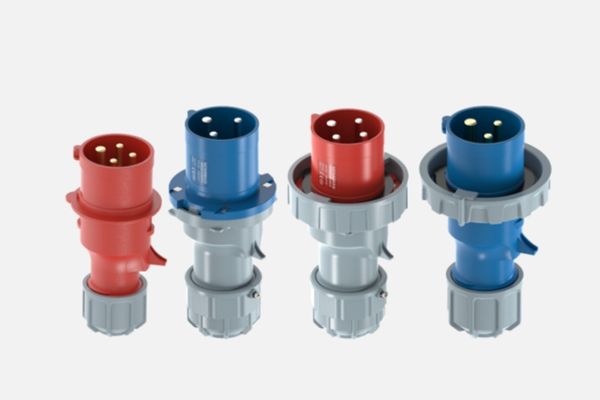
Struggling to choose the right industrial plug? A wrong choice can lead to equipment failure, costly downtime, and serious safety risks. I'll help you get it right.
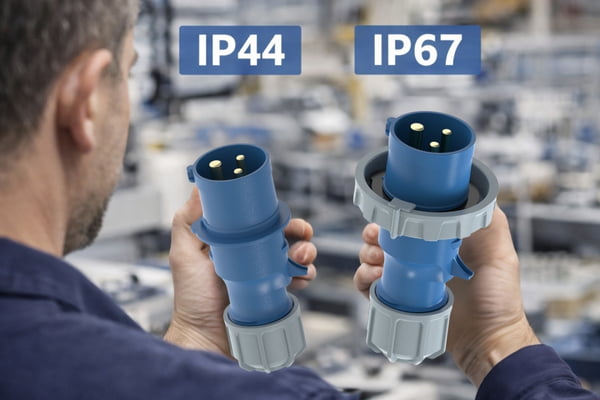
The main types of industrial plugs are categorized by current (16A, 32A, 63A, 125A), protection level (IP441 for indoor splash protection, IP672 for temporary water immersion), and the number of poles (e.g., 3, 4, or 5-pin) to match specific voltage and power requirements.
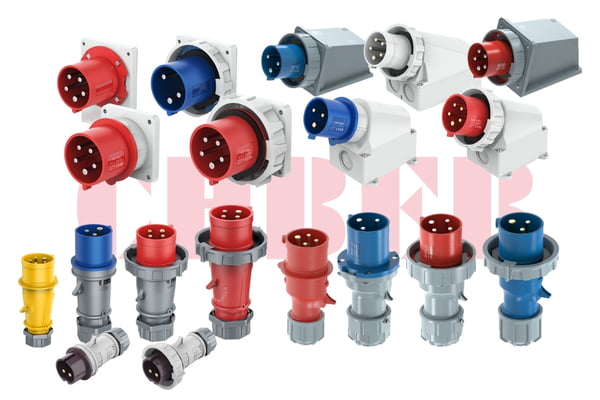
I've spent decades in this industry, and I've seen firsthand how a simple connector can make or break a project. It’s not just a piece of plastic; it’s the lifeline for your machinery. Understanding the differences is the first step to ensuring your operations run smoothly and safely. Let's break it down so you can choose with confidence.
What are the common types of industrial plugs?
At first glance, all industrial plugs might look the same. But picking the wrong one means your equipment either won't work or becomes a safety hazard. Let’s clarify the types.
Industrial plugs are mainly classified by three core factors: current rating3 (amperage), protection level (IP rating), and the number of poles4. Choosing the correct combination is essential for ensuring your equipment receives stable power and is protected from the surrounding environment, preventing costly failures.
When we work with a new partner, this is the first conversation we have. It’s not about selling them the most expensive plug; it's about finding the exact right fit for their application. A plug for a small workshop tool is completely different from one needed for a giant generator on a mining site. Getting this right from the start saves a lot of headaches later. To make it simple, I've broken down these types into a table.
How to Choose the Right Type
The choice depends entirely on your application's power demand and environment.
| Category | Options | Common Use Cases |
|---|---|---|
| Current (Amps) | 16A / 32A / 63A / 125A | 16A: Small tools, workshop lighting. 32A: Most common for production lines, pumps. 63A/125A: Heavy machinery, generators. |
| Protection (IP) | IP44 / IP67 / IP68 | IP44: Indoor use, splash-proof. IP67: Outdoor sites, can be submerged briefly. IP68: Long-term submersion, for wastewater plants. |
| Poles (Pins) | 2P+E / 3P+E / 3P+N+E | 2P+E (3-Pin): Single-phase power for small tools. 3P+E (4-Pin): Three-phase power for most industrial motors. 3P+N+E (5-Pin): Three-phase with a neutral line. |
In short, think about "enough power, enough safety." That's the core principle.
Why are industrial plugs so hard to manufacture?
You might think it’s just a plastic shell with some metal pins inside. But a low-quality plug can fail, causing fires or shutting down an entire production line.
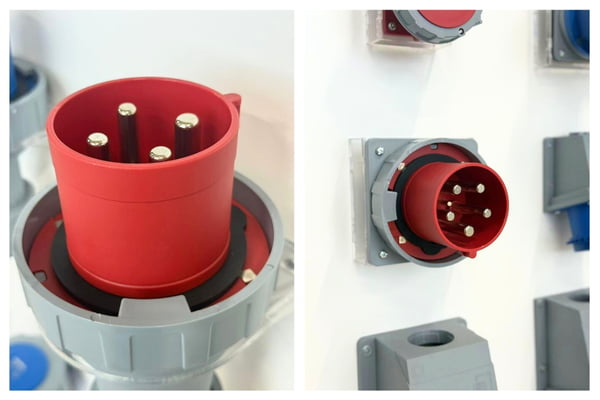
Manufacturing industrial plugs is tough because of three non-negotiable standards: contact precision, sealing performance, and material durability. A tiny error in any of these areas creates an unreliable product that simply can't be trusted in a demanding industrial environment where safety and uptime are everything.
I've seen factories try to cut corners on these points, and the results are always bad. A plug that can't hold a stable connection or lets in a bit of moisture is a ticking time bomb. It’s not just a faulty product; it’s a major liability. That’s why we obsess over these details in our own manufacturing process. These three areas are where quality is truly defined.
The Three Critical Challenges
-
Contact Precision: The metal pins inside the plug must be perfectly spaced. We work with a tolerance of less than 0.05mm. If the gap is even slightly off, the plug might not fit into the socket, or it could create a poor electrical connection. A bad connection generates heat, which can lead to melting, arcing, and even fire. This precision is not something you can achieve with basic machinery.
-
Sealing Performance: This is directly tied to the IP rating. To achieve an IP67 rating, for example, the plug must be completely sealed against dust and water. Even a microscopic gap in the sealing gasket can allow moisture or fine dust to seep in, leading to a short circuit. We test this rigorously to ensure the seal is perfect every single time.
-
Material Durability: The outer shell isn't just any plastic. It must be a high-quality, flame-retardant material5 like PA66 that can resist impacts and extreme temperatures, often from -40°C to 80°C. The metal contacts need to be made from an alloy that resists oxidation. In a factory, a plug will be dropped, kicked, and exposed to chemicals. If it cracks or corrodes after a few years, it’s a failure.
What are the key steps to making a quality industrial plug?
Not all plugs are made the same way. A shortcut during production can lead to a defective product ending up on your site, waiting to fail at the worst possible moment.
To produce a reliable industrial plug6, we follow three core manufacturing stages: precision injection molding of the shell, meticulous assembly and calibration of the contacts, and finally, rigorous sealing and pressure testing. The contact calibration is by far the most difficult and critical step.
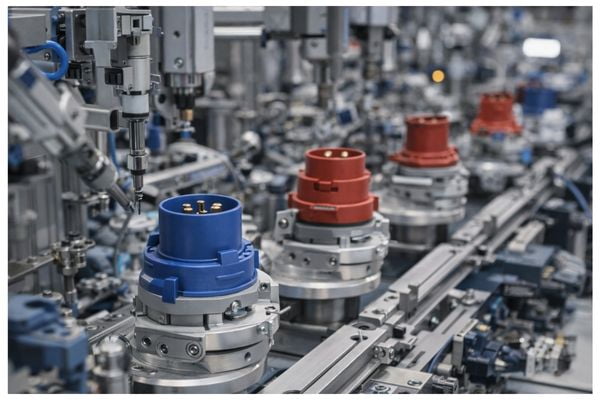
This process is where experience really counts. Many smaller factories struggle and fail at the calibration stage because it requires a delicate balance and specialized equipment. I remember visiting a facility where they were calibrating pins by eye. It's no surprise their products had a high failure rate. Let me walk you through how we ensure quality at each step.
Our Three-Step Quality Process
-
Shell Injection Molding: We start by injecting a specialized flame-retardant plastic into a custom-designed mold. The key here is to ensure the wall thickness of the plug's housing is perfectly uniform. Any thin spots would create weak points that could easily crack under impact, compromising the entire unit.
-
Contact Assembly & Calibration (The Hardest Part!): This is where craftsmanship is crucial. After the copper alloy pins are inserted into the housing, they must be precisely calibrated. If the pins are too loose, the electrical connection will be unstable. If they are too tight, the plug becomes nearly impossible to insert and remove. We use specialized equipment to measure and adjust the insertion force and electrical conductivity, ensuring a perfect balance between a secure connection and smooth operation. This is the step that separates high-quality plugs from the rest.
-
Sealing & Testing: Once assembled, we install the rubber sealing gaskets. Then, the real tests begin. To verify the IP rating, we subject the plugs to high-pressure water jets and fine dust chambers. For IP67-rated plugs, we completely submerge them in water to simulate harsh outdoor conditions, all while monitoring for any sign of leakage or electrical failure. Only the plugs that pass these tests leave our factory.
You need high-performance connectors7 like those from Stäubli, but the budget is tight. Settling for cheaper, unreliable alternatives just leads to constant failures and costly project delays.
We deliver Stäubli-level quality for a fraction of the cost by controlling the entire manufacturing process and eliminating the brand premium. A client from South Africa proved this when he compared our 125A plug to a Stäubli sample, found identical performance, and immediately signed a three-year deal.
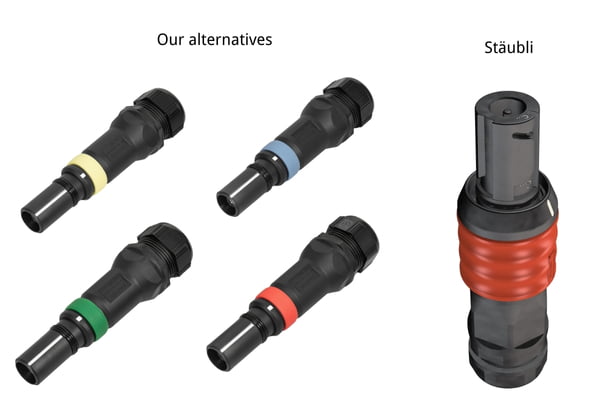
This story is one of my favorites because it perfectly illustrates our value proposition. A client from South Africa, who builds outdoor construction equipment, came to us with a serious problem. The standard industrial plugs he was using kept failing under the intense African sun—the plastic would warp, and the pins would loosen, causing power outages on his sites. He knew Stäubli's high-current connectors were reliable but the price was just too high for him to stay competitive.
The Head-to-Head Test
He flew to our factory in Wenzhou with a Stäubli 125A connector in his bag. He was direct: "I need this exact quality. If you can match it at a better price, we have a deal."
- Visual & Feel: We placed our 125A IP67 connector next to his Stäubli sample. The dimensions, interface, and housing structure were identical. He commented that even the tactile feel of plugging and unplugging was the same. Our pin spacing tolerance was under 0.03mm, just like the premium brand.
- Performance Tests: He watched as we put our plug through its paces in our lab. We ran a high-temperature test to simulate 45°C sun exposure, a full immersion sealing test, and a 500-cycle insertion test. The results were a perfect match with the data for the Stäubli sample. In fact, our custom high-temperature housing showed even less deformation after the heat test.
- The Price: When we told him our price was half of what he was paying for Stäubli, he was stunned. "Is this really the same configuration? No cut corners?" We showed him our raw materials—the same grade of flame-retardant plastic and copper alloy—and our IEC 60309-compliant production line. The only thing missing was the big brand name and its associated markup.
He signed a three-year contract on the spot. Today, he tells us our plugs have eliminated his downtime issues and cut his annual procurement costs in half.
Conclusion
Choosing the right industrial plug is about matching the specs to your needs. With the right manufacturing partner, you can get top-tier, reliable quality without paying for the brand name.
About CHBEBplugs
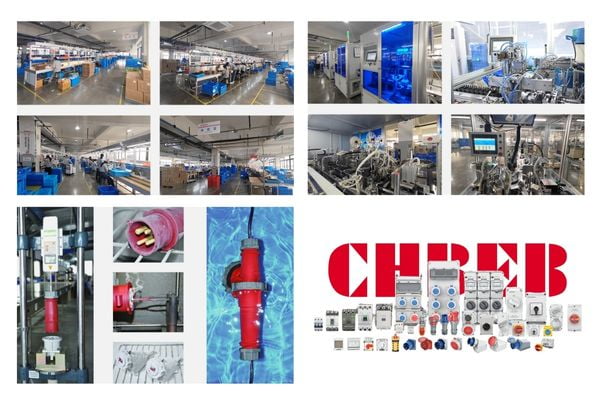
CHBEBplugs is the industrial plug and socket brand under the CHBEB Group, backed by over 60 years of power industry experience. We specialize in export-oriented B2B manufacturing of industrial plugs, sockets, socket boxes, and power connection systems. Supported by China’s mature electrical industry clusters, we provide IEC-compliant products, OEM/ODM customization, and stable large-volume supply for global EPC and industrial projects.
Find out how IP44 ratings protect plugs from water and dust in indoor settings. ↩
Explore the advantages of using IP67 rated plugs for outdoor and harsh conditions. ↩
Learn how current ratings impact the performance and safety of industrial plugs. ↩
Understand how the number of poles in a plug influences its compatibility and use. ↩
Discover how flame-retardant materials enhance safety in industrial plug applications. ↩
Learn the key features to look for when selecting a reliable industrial plug. ↩
Discover the benefits of using high-performance connectors in industrial applications. ↩