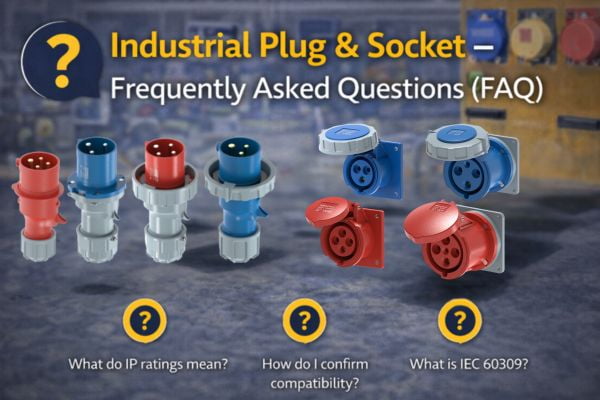
FAQ: Industrial Plugs & Sockets
1) What is the difference between an industrial plug and a domestic plug?
Industrial plugs and sockets are designed for high-current, continuous-duty, and harsh environments, while domestic plugs are intended only for low-current, indoor household use.
Industrial plugs feature:
- Higher current ratings (16A–125A)
- Stronger materials and thicker copper pins
- Mechanical keying to prevent wrong connections
- Protection against dust, water, vibration, and heat
Using domestic plugs in industrial applications can cause overheating, equipment failure, and serious safety hazards.
2) How do I choose the correct amperage (16A, 32A, 63A, 125A)?
Amperage must match the actual load current of your equipment, not just “what fits.”
- Choosing too low → overheating, melting, fire risk
- Choosing too high → incompatibility and unsafe connections
IEC 60309 plugs are physically sized by amperage, which prevents mismatching by design. If you are unsure, always select based on equipment nameplate data or consult the manufacturer.
3) What is the difference between IP44 and IP67 industrial plugs?
IP rating defines environmental protection, not electrical capacity.
- IP44: Splash-proof, suitable for indoor workshops and dry industrial environments
- IP67: Dust-tight and waterproof, suitable for outdoor use, wash-down areas, food processing, and construction sites
IP67 is not “always better”—it is only necessary when the environment demands it.
4) What does “clock position” mean on an industrial plug?
Clock position refers to the position of the earth (ground) pin, expressed like a clock face (e.g., 6h, 3h).
It is a mechanical safety key that:
- Identifies voltage and frequency
- Prevents connecting plugs and sockets with incompatible electrical systems
If the clock position is wrong, the plug simply will not fit—this is intentional and protects equipment and personnel.
5) Why are industrial plugs color-coded?
Color coding is a visual safety system defined by IEC 60309.
Common examples:
- Yellow: 100–130V
- Blue: 200–250V (single-phase)
- Red: 380–480V (three-phase)
This allows operators and maintenance staff to instantly identify voltage systems and avoid dangerous misconnection errors.
6) Is IEC 60309 mandatory for industrial applications?
For most international industrial projects, IEC 60309 is considered a baseline requirement, especially for:
- EPC projects
- Exported machinery
- Temporary power systems
- Safety-inspected facilities
Using non-standard connectors can lead to inspection failure, project delays, or market access restrictions.
7) Can industrial plugs be disconnected under load?
No. Disconnecting under load is dangerous.
Pulling a plug while current is flowing can cause:
- Electrical arcing
- Severe injury
- Damage to contacts and equipment
For this reason, switched sockets or mechanical interlocks are recommended in higher-risk applications.
8) What is the difference between a standard socket, switched socket, and mechanical interlock?
- Standard socket: No local isolation; unplugging under load is possible (not recommended)
- Switched socket: Integrated ON/OFF switch allows local power isolation
- Mechanical interlock socket: Physically prevents plug insertion or removal unless the power is switched OFF
Mechanical interlocks provide the highest level of operator safety and eliminate human error.
9) When should I choose a mechanical interlock socket?
Mechanical interlocks are strongly recommended when:
- High current equipment is used
- Operators may be untrained or rotate frequently
- Water, cleaning, or harsh environments are present
- Safety compliance requirements are strict
They ensure the correct operating sequence by design, not by instruction.
10) Can industrial plugs and sockets be customized (OEM/ODM)?
Yes. OEM/ODM customization is common for industrial plugs, including:
- Custom colors (brand or voltage identification)
- Logo and private labeling
- Special pin or clock configurations
- Custom packaging
A qualified manufacturer can handle design, tooling, testing, and certification as part of the process.
11) Will customized industrial plugs still meet IEC and safety certifications?
Yes—if designed and tested correctly.
Professional manufacturers ensure that:
- Custom products follow IEC 60309 dimensions and safety rules
- Materials meet electrical and mechanical standards
- Products pass required certification and testing
Customization does not mean non-compliance when handled properly.
12) What happens if I choose the wrong industrial plug or socket?
The risks include:
- Overheating and connector failure
- Production downtime
- Safety inspection failure
- Electrical accidents or fire hazards
Industrial plugs and sockets should be treated as safety-critical components, not interchangeable accessories.
Final takeaway: Choosing the right industrial plug and socket is not about size—it’s about safety, compatibility, and long-term reliability. Correct selection at the design stage prevents costly failures and protects both people and equipment.