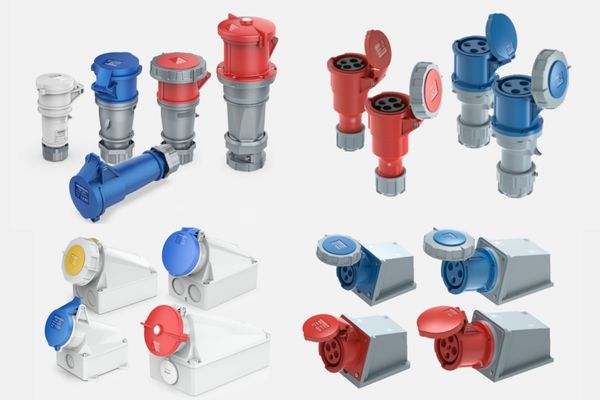
Are you sourcing industrial sockets and think they are simple plastic shells? This common mistake can lead to major quality issues. I will show you the hidden complexity inside.
The manufacturing of an industrial socket1 is a high-precision process involving multiple steps. It requires precise assembly of complex copper components2, concentricity correction3 after molding, and sophisticated waterproofing. The most critical stage is the positioning and assembly of internal parts, not just the injection molding.
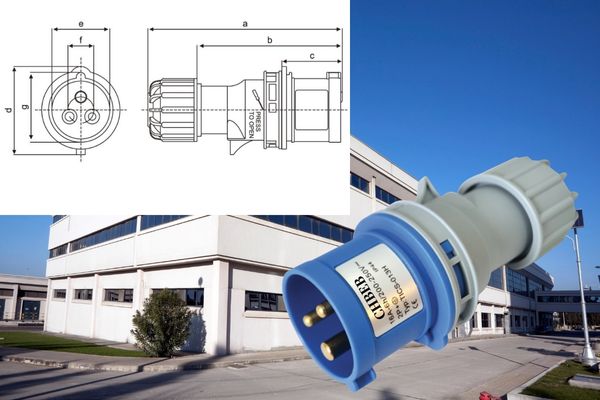
Now that you have a basic idea, let's explore why this process is so much more demanding than it appears. I've spent decades in this industry, and the difference between a good socket and a bad one comes down to details most people never see. We will look at the internal components, the hidden manufacturing challenges, and even the future of socket technology. This will help you understand what to look for when you choose a supplier.
Why are the internal components of a socket so complex to assemble?
You might think the inside of all sockets is the same. But poor internal assembly is a direct cause of overheating, connection failure, and even fire. Let's look at the many precise parts.
The internal complexity comes from multiple copper parts, including contacts, terminals, and plates. Each part must be perfectly aligned. This ensures proper insertion force, grip, and electrical contact, which is far more demanding than assembling a simple plug.
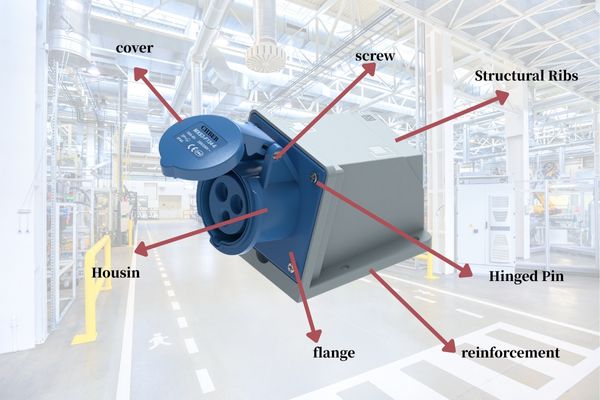
An industrial socket is not just a hollow shell. Inside, it's a completely different story compared to a plug. A plug has solid pins, which are relatively simple. A socket, however, contains a whole system of copper parts. There are the socket contacts4 that grip the plug pins, the terminal structures for wiring, and various fixing and grounding plates. Every single one of these parts must be positioned with extreme accuracy. If the alignment is off by even a tiny fraction, the plug won't insert smoothly. It might feel stuck or loose. Worse, it can cause poor contact, leading to heat buildup and eventual failure. This is why standard injection molding machines are often not good enough. They can't guarantee the precision needed to hold all these copper parts in the right place. That's why we, and other mature manufacturers in regions like Wenzhou and Shanghai, invest in specialized copper stamping and automatic positioning equipment.
Socket vs. Plug: A Quick Comparison
| Feature | Industrial Plug | Industrial Socket |
|---|---|---|
| Copper Parts | Simple (Solid Pins) | Complex (Contacts, Terminals, Plates) |
| Key Challenge | Pin Strength & Shape | Component Alignment & Grip Force |
| Assembly | Relatively Straightforward | High-Precision & Labor-Intensive |
| Performance | Must fit correctly | Must grip, connect, and release reliably |
Have you ever sourced sockets that look good but fail quality checks? This is often due to hidden manufacturing flaws5 that many suppliers won't talk about. I'll reveal two major challenges.
The two biggest challenges are "concentricity correction3" and complex waterproofing. The socket holes must stay perfectly aligned after molding. The waterproof seal also needs to balance multiple mechanical forces, making it extremely difficult to get right consistently.

Beyond the basic assembly, two unique problems make socket production a real engineering test. These are the issues that separate the expert manufacturers from the rest. They are often the root cause of product failures that seem mysterious to the buyer. Getting these two things right requires deep process knowledge and very strict quality control6.
The Problem of Concentricity Correction
After the plastic shell of the socket is injection molded, a critical problem emerges. As the plastic cools, it can shrink unevenly. This tiny, almost invisible change can shift the position of the socket holes. We call this a loss of "concentricity." The holes are no longer perfectly aligned and vertical. The result? When you try to insert a plug, it doesn't go in smoothly. You have to wiggle it or force it. This is a very common issue in the industry and a clear sign of poor manufacturing control. Correcting this requires special tools and a dedicated step in the assembly process7 to ensure every hole is perfectly aligned before the socket is finalized.
The Complexity of a Waterproof Seal
The waterproof structure of a socket is much more complicated than a plug's. For a socket to be truly IP67 rated, everything has to work together perfectly. The main body must be strong. The sealing ring needs the exact right amount of compression. The flip cover has to close with enough force. The hinge must have the right tension. The spring that snaps the cover shut needs the correct rebound force. If any of these are slightly off due to cooling variations, the whole system fails. The cover might not close tightly, or the seal won't be compressed properly. The socket will then fail a water immersion test. It's a delicate balance of multiple mechanical forces8.
Can smart technology make industrial sockets safer?
Overloaded circuits in a factory can cause fires. The scary part is you often don't know there's a problem until it's too late. We are now exploring smart technology9 to prevent this.
Yes, smart technology can make industrial sockets much safer. By integrating features like thermal monitoring, a smart socket could alert users to overheating issues long before they become a fire hazard. This prevents equipment failure and improves plant safety.
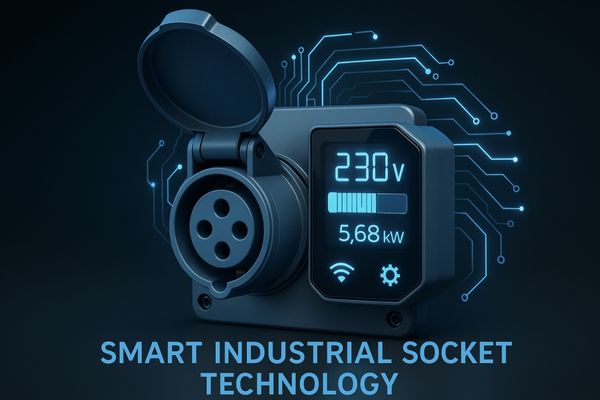
I remember seeing a news story about a UK company, CI Global, that launched a smart socket with thermal monitoring. It really stuck with me. The next day in our team meeting, I raised an idea. What if our industrial sockets could do that? In factories, a burning socket is usually only discovered when someone smells smoke or sees flames. By then, the damage is already done. This is a reactive way to deal with a serious safety hazard. We believe there is a better way.
We started discussing how we could integrate similar technology. Imagine an industrial socket that could detect when it's starting to overheat. Instead of silently failing, it could send an alert to a central control system or a maintenance manager's phone. This would allow staff to address the problem immediately. They could investigate the cause, like an overloaded machine or a bad connection, before it leads to a fire or catastrophic equipment failure. This moves safety from being reactive to proactive. As a company with a long history in the power industry, we feel a responsibility to push for such innovations. We are now actively working on a plan to develop and launch a new generation of smart industrial sockets to help our partners make their facilities safer.
Conclusion
Industrial socket manufacturing is a precise engineering process, not simple molding. It requires expertise in assembly, correction, and waterproofing to ensure the highest levels of safety and reliability.
Understanding the features of industrial sockets can help you choose the right one for your needs. ↩
Learn about the significance of copper components in ensuring the performance and safety of industrial sockets. ↩
Discover how concentricity correction impacts the performance and reliability of industrial sockets. ↩
Learn about the role of socket contacts in ensuring reliable electrical connections. ↩
Understanding common manufacturing flaws can help you avoid poor-quality sockets. ↩
Explore effective quality control measures that ensure the reliability and safety of industrial sockets. ↩
Understanding the assembly process can help you appreciate the complexity involved in manufacturing quality sockets. ↩
Discover how mechanical forces play a crucial role in the functionality and safety of industrial sockets. ↩
Explore the innovative applications of smart technology in enhancing the safety of industrial sockets. ↩